
 language
News and Information
The Company is Committed To The Production, Sales, Design, Installation, And Maintenance Of Process Instruments And Intelligent Control System Solutions.

The Company is Committed To The Production, Sales, Design, Installation, And Maintenance Of Process Instruments And Intelligent Control System Solutions.
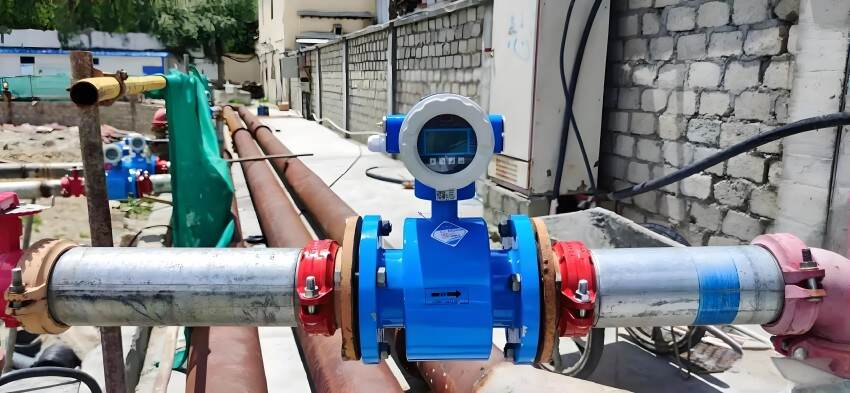
There are two types of faults that occur during the operation of electromagnetic flow meters: one is the fault of the instrument itself, which is caused by damage to the instrument structure or components; The second is faults caused by external factors, such as improper installation, flow distortion, sedimentation, and scaling.
This article explores these two types of faults.
1、 No flow signal output from the instrument
1. Cause analysis
This type of malfunction is more common during use, and the reasons are generally:
(1) The power supply of the instrument is abnormal;
(2) The cable connection is abnormal;
(3) The liquid flow condition does not meet the installation requirements;
(4) Damaged sensor components or adhesion layer on the measuring inner wall;
(5) The converter components are damaged.
2. Solution
(1) Confirm that the power has been connected, check if the output voltage of the power circuit board is normal, or try replacing the entire power circuit board to determine its quality.
(2) Check if the cables are intact and if the connections are correct.
(3) Check the direction of liquid flow and whether the liquid inside the tube is filled. For electromagnetic flow meters that can measure in both forward and reverse directions, although they can measure in different directions, if the set displayed flow rate does not match in both directions, it must be corrected. If dismantling the sensor requires a large amount of work, you can also change the direction of the arrow on the sensor and reset the display instrument symbol. The main reason for the pipeline not being filled with liquid is due to the improper installation position of the sensor. Measures should be taken during installation to avoid the liquid inside the pipeline not being fully filled.
(4) Check if the electrodes on the inner wall of the transmitter are covered with a liquid scar layer. For measuring liquids that are prone to scar formation, they should be cleaned regularly.
(5) If it is determined that the fault is caused by damage to the converter components, replace the damaged components.
2、 Output value fluctuation
1. Cause analysis
Most of these faults are caused by the influence of the measuring medium or external environment, and can be eliminated by themselves after external interference is eliminated. To ensure the accuracy of the measurement, such faults cannot be ignored. In some production environments, the vibration of measuring pipelines or liquids can cause the circuit board of the flow meter to loosen and also cause fluctuations in the output value.
2. Solution
(1) Confirm if it is due to the process tank, and if the fluid is indeed pulsating, the flow meter will only accurately reflect the flow condition. After the pulsation ends, the fault can be resolved on its own.
(2) Electromagnetic interference caused by external stray currents, etc. Check whether there are large electrical appliances or welding machines working in the instrument operating environment, and confirm that the instrument is grounded and the operating environment is good.
(3) When the pipeline is not filled with liquid or there are bubbles in the liquid, both are caused by process reasons. At this point, the process personnel can be requested to confirm that the output value can be restored to normal after the liquid tube is full or the bubbles are flat.
(4) The transmitter circuit board is a plug-in structure, which often causes the power board of the flowmeter to loosen due to the large vibration of the pipeline or liquid measured on site. If it is loose, the flowmeter can be disassembled and the circuit board can be re fixed.
3、 The measured flow value does not match the actual value
1. Cause analysis
(1) Is the transmitter circuit board intact;
(2) When the liquid flow rate is too low, the measured liquid contains tiny bubbles, which rise and gradually gather above the pipeline, causing a change in the liquid flow area. When there is too much gas, interference signals may also be generated, affecting the measurement accuracy;
(3) Inaccurate measurement caused by poor connection of signal cables or decreased insulation performance of cables during use; (4) The parameter settings of the converter are inaccurate.
2. Solution
(1) Check if the transmitter circuit board is intact. If the junction box is flooded or corroded by corrosive tested liquids, it can lead to a decrease or damage in electrical performance. At this point, the circuit board should be replaced.
(2) Ensure that the flow rate of the measured liquid in the pipeline is above the minimum flow limit value, so that the transmitter can operate normally.
(3) Check if the signal cable connection and insulation performance are intact. If there is any looseness in the signal cable, simply reconnect it; If the insulation of the cable does not meet the insulation requirements, it is necessary to replace the cable with a new one.
(4) Reset the converter settings and verify the zero and full values of the converter.
4、 Output signal exceeds the full range
1. Cause analysis
The main reasons for such malfunctions are:
(1) Signal cable wiring errors or cable disconnection;
(2) The parameter settings of the converter are incorrect;
(3) The converter and sensor models are not compatible.
2. Solution
(1) Check if the signal circuit connection is normal. If the signal circuit is disconnected, the output signal will exceed the full capacity value. At this time, it is necessary to reconnect the signal cable correctly. At the same time, it is necessary to check whether the insulation performance of the cable is intact. If it no longer meets the requirements, the cable needs to be replaced.
(2) Thoroughly check whether the parameter settings, zero point, and full degree of the converter meet the requirements.
(3) If it is found that the converter and sensor models are not compatible, it is necessary to contact the manufacturer for replacement.
5、 Zero point instability
1. Cause analysis
(1) The pipeline is not filled with liquid or the liquid contains bubbles.
(2) Subjectively, it is believed that there is no flow of liquid in the tube pump, but in reality, there is a slight flow.
(3) Reasons related to liquids, such as poor uniformity of liquid conductivity and electrode contamination.
(4) The insulation of the signal circuit has decreased.
2. Solution
(1) The pipeline is not filled with liquid or there are bubbles in the liquid due to process reasons. In this case, the process personnel should be requested to confirm. After the process is normal, the output value can be restored to normal.
(2) There is a slight flow in the pipeline, which is not a malfunction of the electromagnetic flowmeter.
(3) If impurities deposit on the inner wall of the measuring tube or scale forms on the inner wall of the measuring tube, or if the electrode is contaminated, zero point changes may occur, and cleaning is necessary at this time; If there is not much change in the zero point, you can also try resetting it.
(4) Due to the influence of environmental conditions, dust, oil stains, etc. may enter the case body. Therefore, it is necessary to check whether the insulation of the electrode part has decreased or been damaged. If it does not meet the insulation requirements, it must be cleaned.