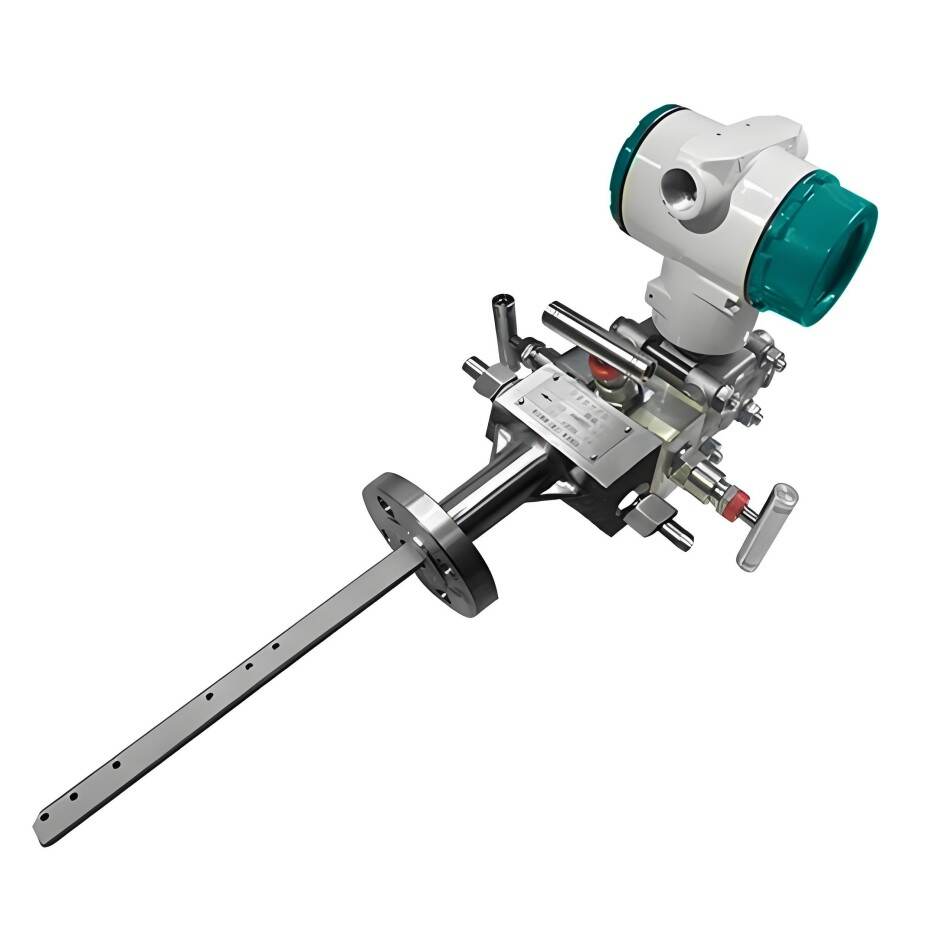
Product Overview:
LDW Velbar flowmeter is suitable for high-precision flow measurement of gases, liquids, and vapors. Weiliba is a differential pressure and rate averaging flow sensor that measures flow by measuring the differential pressure generated by the sensor in the fluid. The power bar reflects the true flow velocity of the fluid, with an accuracy of ± 1.0% and a repeatability of ± 0.1%. The outstanding advantage of Weiliba is that it outputs a stable and pulsation free differential pressure signal
Product Features:
The probe with a bullet head cross-sectional shape can generate accurate pressure distribution and a fixed fluid separation point; The low-pressure tapping holes located on both sides behind the probe and before the fluid separation point can generate stable differential pressure signals and effectively prevent blockages. The internal integrated structure can avoid signal leakage, improve the strength of the probe structure, and maintain long-term high accuracy.
3. Anti clogging design of Powerbar probe. With its complete anti blocking design, the Powerbar flow probe completely eliminates the disadvantage of easy blockage of insertion flow probes such as Anuba, and achieves a strong anti blocking level of the averaging tube flow probe.
The high-pressure tapping hole of the probe will not be blocked, forming a high-pressure zone at the front of the probe. The pressure is slightly higher than the static pressure of the pipeline, preventing particles from entering. Please note that the fluid velocity at the high-pressure tapping hole of the probe is zero, and no object will enter the tapping hole. When starting up, the fluid enters the bend under the static pressure of the pipeline, quickly forming a state of pressure equilibrium. After the pressure equilibrium state is formed, the fluid encounters high pressure at the inlet of the bend, detours and no longer enters the bend.
Under normal circumstances, dust, sand, and particles are concentrated at the rear of the probe under the action of vortex force, achieving essential blockage prevention through the low-pressure hole of the power bar. That's why autumn leaves always gather behind windward houses. Other probes have low-pressure pressure tapping holes located in the vacuum zone at the tail of the probe. Under the action of vortex forces, the low-pressure pressure tapping holes of the probe are quickly blocked by impurities brought by eddy currents. The unique design of Weiliba allows the low-pressure tapping holes to be located on both sides of the probe side, at the front of the fluid separation point and wake area. This design fundamentally prevents blockage and can generate a very stable low-voltage signal.
Advantages of probes:
Can measure multiple media and has a wide range of applications
High precision and large range ratio
The probe pressure hole is inherently anti blocking
● Stable measurement signal with minimal fluctuations
Low pressure loss of pipeline permanent nine
Special high-strength bullet shaped single piece dual chamber structure
Low installation cost, basically maintenance free
● Can be installed and maintained online
Working Principle:
When fluid flows through the probe, a high-pressure distribution area is generated in its front, and the pressure in the high-pressure distribution area is slightly higher than the static pressure of the pipeline. According to the Bernoulli equation principle, the velocity of the fluid increases as it flows through the probe, creating a low-pressure distribution area at the back of the probe. The pressure in the low-pressure distribution area is slightly lower than the static pressure of the pipeline. After the fluid flows through the probe, a partial vacuum is generated at the back of the probe, and vortices appear on both sides of the probe. The cross-sectional shape, surface roughness, and position of the low-pressure tapping hole of the average velocity flow probe are key factors determining the performance of the probe. The stability and accuracy of low-voltage signals play a decisive role in the accuracy and performance of the uniform velocity probe. The Weiliba average velocity flow probe can accurately monitor the average differential pressure generated by the average velocity of the fluid. The Weiliba average flow probe has multiple pairs of pressure tapping holes arranged according to certain criteria in the high and low pressure areas, making it possible to accurately measure the average flow velocity.
Product Parameters:
1. Performance indicators of Weiliba flow measurement system
Measurement accuracy: ± 1% Repeatability accuracy: ± 0.1%
Applicable pressure: 0-40MPa Applicable temperature: -180 ℃~+550 ℃
Measurement upper limit: depends on probe strength Measurement lower limit: depends on measurement lower limit Differential pressure requirements
Range ratio: greater than 10:1
Applicable pipe diameter: 38mm~9000mm round pipe, square pipe
Applicable media: Full tube, unidirectional flow, unidirectional gas, steam, and liquid with viscosity not exceeding 10 centipoise
The application range of Veliba is extremely wide, and it is widely used in various gases, liquids, and vapors
Measurement of steam, the following are typical application media.
Gas/Liquid/Steam
Natural gas/cooling water/saturated steam
Compressed air/boiler water/superheated steam
Gas/desalinated water
Gas hydrocarbons/liquid hydrocarbons
Hot air/low-temperature liquid
Furnace gas/heat transfer liquid
For more product information, please consult our toll free hotline at +0086 400 880 6367

 language