
 language
News and Information
The Company is Committed To The Production, Sales, Design, Installation, And Maintenance Of Process Instruments And Intelligent Control System Solutions.

The Company is Committed To The Production, Sales, Design, Installation, And Maintenance Of Process Instruments And Intelligent Control System Solutions.
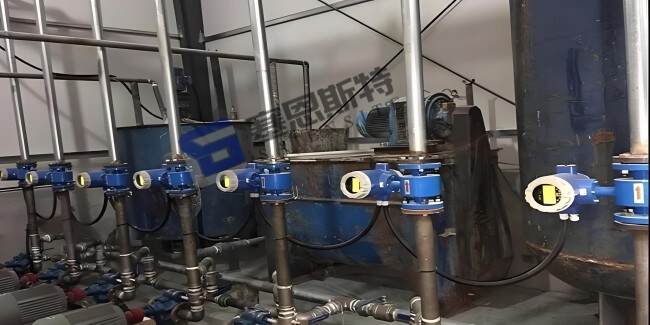
The measurement principle of electromagnetic flowmeter is Faraday's law of electromagnetic induction, which measures the volumetric flow rate of conductive liquids and slurries in closed pipelines, including highly corrosive liquids such as acids, bases, salts, etc.
The false alarms that occur in the measurement of cooling water in the steel industry using electromagnetic flow meters are mostly caused by bubbles rubbing against the electrodes, resulting in a brief induction signal of zero, which is a cavitation phenomenon,
We call this type of malfunction bubble noise. Below are some methods to avoid and solve the problem of bubble noise.
Firstly, the installation should meet the length requirements of the upstream straight pipe section of the electromagnetic flowmeter, standardize the installation of the instrument, choose a location far away from the heat source, use the pipeline flow rate reasonably, and select PFA fluoroplastic lining with high smoothness and high-purity alumina industrial ceramic conduit. These measures will help prevent or reduce the occurrence of vortices and gas separation. That is to say, improving the manufacturing process of sensors, improving the environmental and installation conditions of instruments, and adopting measures such as installing exhaust valves upstream of instruments may avoid the occurrence of problems.
Secondly, setting the damping time and function of the electromagnetic flowmeter reasonably can also solve the false alarm caused by bubble noise measurement. The selection of damping time is based on the pulse width of bubble noise in the flow signal. Generally, the damping time should be 3-5 times the pulse width of bubble noise. If the pulse width of bubble noise is 10 seconds, the damping time should be taken as 30-50 seconds. The specific selection should be based on the required control accuracy, with a control error of 5% for 3 times the pulse width and a control accuracy of over 1% for 5 times the pulse width. Increasing the damping time of the instrument can effectively solve the impact of pulse type bubble noise, but it also brings the disadvantage of slow response, that is, when the actual flow fluctuates, the instrument response is very slow.
This is undoubtedly a challenge for cooling water systems that require sensitive control. To solve this problem, intelligent electromagnetic flow meters can use software logic judgment, that is, the method of handling gross errors. When such a malfunction occurs, the insensitive time and amplitude limit of the flow rate are adjusted to determine whether it is a change in flow rate or a bubble rubbing against the electrode. If it is not the noise caused by bubbles rubbing against the electrodes, the CPU will perform normal sampling, computation, and digital filtering; If it is determined that bubble noise is generated, cut off the measurement value and maintain the previous flow measurement value. In this way, the damping time during normal flow measurement is still 3-6 seconds. Only when there is bubble noise, the insensitive time will be extended according to the pulse width setting, and the system control time will also be extended.
When we reasonably choose the change rate limit value and insensitive time value of the electromagnetic flow converter with coarse error suppression function, the converter can not only suppress false alarms caused by bubble noise, but also maintain the set damping time value of the instrument's response speed during normal operation.
The study of bubble noise in electromagnetic flow meters should be conducted by simulating the electrodes of electromagnetic flow sensors with bubbles, but currently there is no such condition. Therefore, we only use electromagnetic flow signals
Switching the generator signal to simulate bubble noise. Appropriately selecting damping time and intelligent electromagnetic flowmeter to deal with bubble noise faults, observing the changes in flowmeter display and output signals, and judging the obvious effect of dealing with bubble noise. Switch the switch of the standard signal source for the intelligent electromagnetic flowmeter, quickly set the flow rate and zero point, maintain the signal at zero for as long as needed, and simulate the occurrence and existence of bubble noise. Change the damping time of the instrument and set different rate of change limits and insensitive time values to test the changes in the instrument output. The results indicate that increasing damping time and intelligent bubble noise processing can both achieve output without significant changes, with the latter being more conducive to improving measurement reaction speed during normal measurement.